Welcome to WordPress. This is your first post. Edit or delete it, then start writing!
Blog
-
Part C Unit 2 ~ Do the leadership:
Pre-event preparation:
I
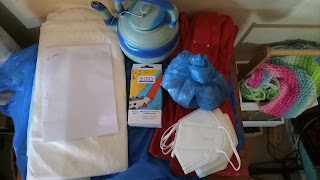
The afternoon before my art event, I did a supply check making sure I had all the necessary equipment (My mum and I, bought all the missing things we needed that week). The art event happened at my house, and there were 2 different locations where we did things. We used a porch table (in a quieter location!) to do the silk painting. And then the place where we did the koko donda, was round the back of my house. I cleaned both places, and laid out the necessary supplies.
– Material on the left, kettle for pouring the dyes, and rubber bands. And safety equipment on the far right.
Koko Donda supplies:
– Plastic sheet to do it on
– Dyes in the blue bag
-
Part B Unit 2 ~ Arrange the leadership:
Overview of my event:
At my art event there are going to be 2 people, Graciella C. (one of my friends, who is the same age as me) She is quite a dynamic, fun person who likes art and has done dyeing before. And also my sister Felicity, will also be participating. They are both chatty people, who enjoy art so it should be good fun. We’re going to be doing a silk painting, and some dyeing.
-
Part A Unit 1 ~ Identify and agree an appropriate arts challenge
Identifying and Agreeing on an Arts Challenge
Art for me personally, is a means of expression. The book “A Wrinkle in time” discusses the idea of how our language is sometimes inadequate to express certain thoughts, feelings, and ideas. One of the characters sums it up by saying: “Explanations are not easy when they are about things for which your civilization still has no words.” This is where Art (Poetry, Music, Painting, cooking, and much more!) step in, providing a way for us to express our thoughts and emotions, in ways we are not able to by speaking. I also do Art because i find it relaxing, and restorative. There is a simple joy in creating. I love being able to just sit down, with an empty piece of paper and some paints and being able to create! Art is also a process for me, just getting to the point of beginning a piece means there has already been a process in my thoughts, of what I have in mind for that piece and what am i wanting to get out out of my artwork today. Of course it varies on the day, how I’m feeling and so on. Quite often i don’t even plan a piece, i just start creating and see where i end up. Art is also a means of exploration. Whether its exploring nature (something I love doing), or exploring colour, and emotions/ideas. Vincent Van Gogh, once said: “If you truly love nature, you will find beauty everywhere.” I love that! Art and beauty are things that should be shared, and delighted in. I want to find beauty in different surroundings, and I want to express it to others. Its my hope as I keep doing art, that people will be able to look at my pieces; and get a sense of what i was feeling and what i wanted to convey when i painted that. I also want to learn new things about art, and grow in my ability to do art.
My challenge ~
What i would like to challenge myself to do is: The overall aim is to – Create a “mini art gallery”. However in the process of doing this I would like to learn some new art forms. Firstly I would like to learn how to do Silk Painting. I have a little past experience of doing this, I was inspired to do it from my oldest sister, who took up silk painting when I was younger. Secondly I live between UK and the Africa, yet during my time in Africa I’ve have never learnt from the Artisans there about how they do their work. I am going to do two particular workshops, one on African Batik, and the other on Koko Donda (which is basically a type of tie dyeing.) And natural dyeing. I think challenging myself to make an “mini gallery” will be fun, and a learning experience. It will challenge me in my ability to produce art, as i am definitely not very good at keeping myself working regularly. With this goal in mind, I want to challenge myself to be creating at least one thing every day. I am excited to learn new art forms, as i do not have much experience with using different medians/textile art. I want to explore creatively with colour and techniques, using both of them to make my artwork more effective. Through all of this it is my goal to learn. experience new things, and enjoy art as i pursue the goal of growing as an Artist!
-
Part A Unit 2 ~ Establish the project’s creative purpose:
Project & Leadership Goals:
I think there are multiple qualities that make up a good leader. Such as enthusiasm for their chosen art form, and being able to convey that enthusiasm is a meaningful way. I think they should have patience when teaching as well. They should be well organised and prepared, and have sufficient knowledge/research on their subject that they’re able to answer questions well, and discuss their art form well and confidently. And of course, good communication skills are very important. Such as encouraging, explaining, and judging how people are finding things and how best to help them.
I would like to develop all of these skills, that I mentioned. But I would particularly like to develop my ability; to be organised and prepared, being on schedule!! I would like to be able to communicate well with others, and I would like to grow my confidence in sharing about art (especially for me personally) with others. I also haven’t had much oppoturnity and experience in teaching/doing art formally. I’m excited for the chance to do this.
-
Workshop #2 Natural Dyeing Workshop ~ (Part B, Unit 1)
Natural Dyeing Workshop ~
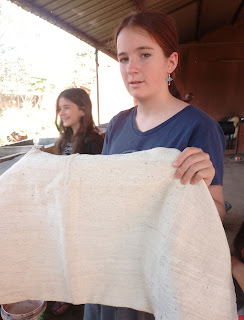
I did this workshop, after doing the Batik one. I mainly chose to do it for contrast at the time, because this method of dyeing uses a lot more natural products. Where basically all the dyes and fixatives for Batik were not natural. I also think it’s more interesting using products from nature as dyes, because it suggests the idea that it’s something you can do in your own back yard/kitchen. Instead of going to a special workshop equipped for it, or buying lots of products.
-
Workshop #3 Koko Donda ~ (Part B, Unit 1)
Koko Donda, Tie Dyeing ~
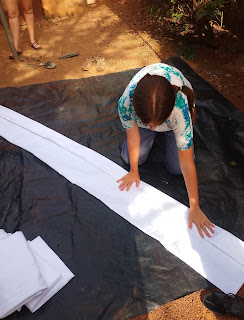
The last workshop that I did was Koko Donda (sometimes called Koko Dunda).This time the person teaching me was a girl, who had recently just learnt it herself;in order to set up her business. She actually was mostly self taught, watching videos on-line, and asking others for advice. She takes orders dyeing the different designs people want on cloth, and then selling it.
Koko donda is basically the African version of tie-dyeing. Only it uses materials that are avaliable here. It actually uses the same dyes as Batik. (So artificial powdered dyes which are first mixed with some caustic acid and sodium carbonate, then hot water is poured in.)
-

Part D Unit 1 – Learn about artists and arts organisations through visits and/or participation:
How Artists have have inspired & helped me:
“Lend your ears to music, open your eyes to painting, and… stop
thinking! Just ask yourself whether the work has enabled you to ‘walk
about’ into a hitherto unknown world. If the answer is yes, what more do
you want?”— Wassily Kandinsky
Wassily Kandinsky was an Russian artist, and colour theorist; who lived from 1886-1994. He is most well known for his pioneering in the area of abstract art, and his colour theory in the west. I will mostly be taking a look at his early pieces, in my study of him.. Kandinsky was influenced by colour as a child, he recalls entering into church buildings and being awed by the play of colour in the stain glass windows. He also enjoyed studying folk art, he liked how they used bright colours against dark backgrounds, and he used that technique in a lot of his earlier work.
He was also noted for comparing painting to composing music. “Colour is the keyboard, the eyes are the harmony, the soul is the piano
with many strings. The artist is the hand which plays, touching one key
or another, to cause vibrations in the soul”. As Kandinsky began to grow as an artist, he found himself leaning to abstract art. He had several noticeable encounters with other artists works that influenced him such as Claude Monet, he especially liked his collection called “Haystacks”. He said that “…Painting took on a fairy-tale power and splendour” after enjoying Monet’s ‘Haystacks’.It was during his time at art school, that Kandinsky began to be recognised as an art theorist, as well as a painter. His style at that time was made up of: using bold brush-strokes, and vibrant colours also with darker backgrounds and brighter foregrounds. he also tended to stay away from painting human figures, mostly focusing on landscapes. I find it interesting how Kandinsky used colours to express his feelings of the subject matter, rather than staying in the confines of its perceived colour.
The Blue Rider (1903)

The Blue Rider, was one of Kandinsky’s most famous paintings, that he painted in the early 1900s. It points toward the style Kandinsky would later adopt (before he went on to full on abstractionism). In this artwork there are various shades of blue used. Most noticeably the blue jacket of the rider, and blue shadow its casting. With blue shadows in the background. And blue shadows, reaching towards the rider. The field is filled with lots of quick, flowing marks. That suggests the idea of motion. The Blue Rider focuses the viewers attention, it is not clearly defined and has an unnatural gait as well. The painting makes you work when looking at it, not every detail is clearly defined. But I think its very effective, and I love how it conveys the motion, and excitement of someone galloping on a horse.
Kandinsky then spent 2 years travelling in Europe. Eventually he settled in the Bavarian town of Murnau (A location where he gained inspiration for many of his art pieces). During his time spent in travelling in Europe, Kandinsky encountered the art work and styles of, Pointillism (Georges Seurat), Post Impressionism (Paul Cezanne), and Fauvism (Henri Matisse). These all greatly influenced Kandinskys own art work and ideas. It was during this time that his abstract style, which he is most well known for today began to develop and come into fruition.The Blue Mountain (1908-1909).

This painting displays his movement towards abstraction, though it is still reminiscent of his earlier style. This piece is quite flat (planar) and uses a broad use of colour. It naturally seems to divide into 4 sections. The sky, the red tree, the yellow tree, and the mountain along with the horses and its riders.
Honestly, On first glance at this piece I was not at all taken. I thought it, and particularly all the shapes he used were quite ugly. The trees especially didn’t seem very ‘tree-like’ to me, I generally like more graceful shapes/lines then the ones he uses. Also I didn’t see the riders at first. But then I decided to take a closer look, and I noticed a lot more. Looking closer I was able to appreciate the brush work he uses, and the broad range of colours which are blended really nicely. I especially like the sun, and its light behind the blue mountain.
Kandinsky kept exploring and developing his art, most well known for this time of his life, for forming: “The Blue Rider” Group, which was to last till the beginning of WW1. It was during this time also that Kandinsky published his book: “On the Spiritual in Art”. Kandinsky very much believed in a spiritual side to art. He thought that colour speaks for itself in art. One writer sums it up by saying: “He wanted a kind of painting in which colours, lines, and shapes, freed from the distracting business of depicting recognizable objects, might evolve into a visual “language” capable—as was, for him, the abstract “language” of music—of expressing general ideas and evoking deep emotions.”
I think its an thought provoking idea of Kandinsky’ that, “Material” things in paintings, really take away the full force and effect that colour can have on us in a piece of art. And that colour was actually like a visual language for him, one that could express emotion, ideas, and thoughts that are difficult to express otherwise.
“…He
believed that colour could be used in a painting as something
autonomous, apart from the visual description of an object or other
form…”Kandinsky also thought that colour had the ability to speak for itself in an painting; and that it is essentially the main character in a piece of art. Here are a couple direct quotes from him that I liked, about colour:
1) “Colour is the keyboard, the eyes are the harmonies, the soul is the piano with many strings. The artist is the hand that plays, touching one key or another, to cause vibrations in the soul.”
2) “Colour is a power which directly influences the soul.”
3) “Colour hides a power still unknown but real, which acts on every part of the human body.”
To wrap of my brief study of him (Kandinsky had an very long art career, which would take an long time even to summarise. So I’ve tried to include things that I found relevant and interesting). I’d just like to look at a couple more of his earlier art works.
Autumn Landscape with Boats (1908)

I think this is quite a cheerful, yet soothing piece. It is characterized by bright colours, and artfully bold brush-strokes. The colour in this piece is doing a lot of the work, with minimal small details in the different objects portrayed. I really like how the water, and the sky look in this piece. The reflections are really pretty in the water, and it conveys the sort of haziness there is, sometimes during Autumn. I like how the brush-strokes are not all in the same direction, the piece wouldn’t work if they were. I find my eyes going to the ship, which is pointing to the trees, and the skyline.
Autumn in Murnau (1908)

Another Autumn Scene, with differences and similarities!This piece has a rugged, simple, yet distinctive beauty to it. The tree, set in the foreground has possibly the most brushwork on it, than anything else in the piece. I love the blue hues! The path and small cluster of houses in the background, also add depth to the painting. Kandinsky merges his own style of painting here, with an landscape scene, in a beautiful and unique way.
Winter Landscape (1909)

This for me has a less graceful fell than the Autumn landscapes. However I still like it! Probably because the long sweeping strokes featured in the water, and the path, are not really seen here. Instead the strokes on the snow are more dot like. Trying to give us a impression of what the snow looks like glittering in the setting sun. Again, the path going round the corner, adds depth to the picture. The mountains in the background which use more blue and black paint, seem to be reminding us that it it winter and a cold night is coming. But for now we are being invited to witness the effects of the seeting sun, in a remote beautiful location.
I’ve really enjoyed studying, and learning about Wasssily Kandinsky. It has helped me to form opinions on art, taking time to notice what I do and don’t like about the piece. I’ve enjoyed thinking about coulor, and the role or plays in a piece; being able to influence our thoughts and emotions, in ways that are sometimes hard to express with ‘material things’.
-
Part C Unit 1 ~ Review Art Events
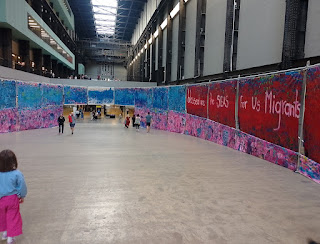
For my Art Events, We went to 3 separate locations. The TateMordern, Fitzwilliam and the Bank-side Gallery.
(These were the three art galleries we ended up visiting. Due to the time frame we had, I wasn’t able to find anything that more closely lined up, with what art I was going to do.)
Visiting the TateMordern:
There was not a lot of actual art work at the Tate which really interested me… I think that was partly because I have mixed feelings about modern art, some of it I like, some of it I don’t like. I also love bright/beautiful colours, The Tate, in general for me personally seemed subdued and lacking in colour in its different pieces. I did find it however, an interesting experience reading and looking at different ways artists were exploring and going further. Not being “conventional” in their art. But using it as an means, to express thoughts, questions and ideas. A lot of the art was expressed in different media to what I lean to. For example there was one artist that used film and light and one that used broken glass. These artists were not trying to communicate beauty but were considering the dystopian theme of brokenness, without restoration. (Not all of them of course, but quite a few).
“Artists often use colour to explore their thoughts or
feelings Their place in the world. Artists have tried to expand the way colour is used, from paint to film to new materials”“Colours are attached to cultural labels, that are powerful”

These are some of the quotes I liked exploring colour! I like the expression “expanding the way colour is used”. And I think its interesting the way different colours do mean different things, in different cultures. One thing I notice going between England, and Africa is even the difference between the colour of people’s clothing. African (traditional) clothing is as a rule a lot more “vibrant” and “poppy”. They print their traditional cloths (pagne) often with lots of patterns, sometimes they are symbolic in meaning. Maybe to their particular people group/religion. Clothing, and the colour of it is definitely a part of their culture. I’d argue less so in England, because people have different ways of expressing their culture (and artwork) than by what they wear. Colours are muted with the rise of a beige palette in clothes and in interior design. I miss colour, colour always seems a celebration in Africa.
I did like seeing just how many different medians/techniques artists are using for their work now, there’s definitely a sense of exploration.
I found this piece quite interesting, done by a Chinese artist (Onoda Minoru),who made this piece using “Oil, gofun and glue on plywood.”
“…. For him, the systematic repetition of dots was a way to think mechanically. Through this technique he hoped to counter the subjectivity of action-based painting. Onoda was also responding to the industrialisation of Japan, during the post-war period. He found inspiration in the ‘vast meaningless’ of machine-made, identically duplicate objects….” I liked the different materials and the dot like marks, he used in creating this piece. And how this particular technique helped him express his feelings. Its interesting how different artists choose to express themselves!

The Snail, 1953, Henri Matisse.
This piece was created by cutting/tearing coloured paper painted with “gouache” and then stuck to a canvas.
“Matisse said of the technique that it ‘allows me to draw in the colour. It is a simplification for me. Instead of drawing the outline and putting the colour inside it – the one modifying the other – I draw straight into the colour’”.
I liked this piece, I think its very effective in its Simpleness. Unlike some pieces which for me personally, were too simple in their design. I didn’t like all the pieces, which were similar to this. I did not find them very attention catching. The defined edges and shapes, seemed very confining, and hard edged to me. Its an interesting idea he brings up, that he likes “drawing straight into the colour” and how for him, this is the way he likes expressing himself.
-
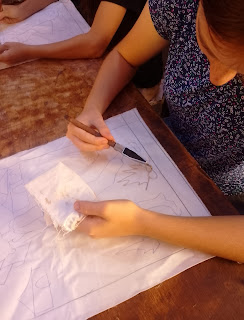
Workshop #1 Batik ~ (Part B, Unit 1)
Batik ~ How and Why:
Doing Batik was an unique and fun experience! I had no prior experience of it (or anything like it, apart from silk maybe; the idea of tracing your designs with gutta is a little similar in how batik uses wax to trace its designs.) Sadly the Batik i did at the workshop – is not really something I can do at home (maybe in the future however I will look at doing some more batik pieces now I am more familiarised with it, and the process.)
I really wanted to try doing this because: I’m curious how its done, what I can learn from it. And I’m interested in it’s history/cultural significance.


